
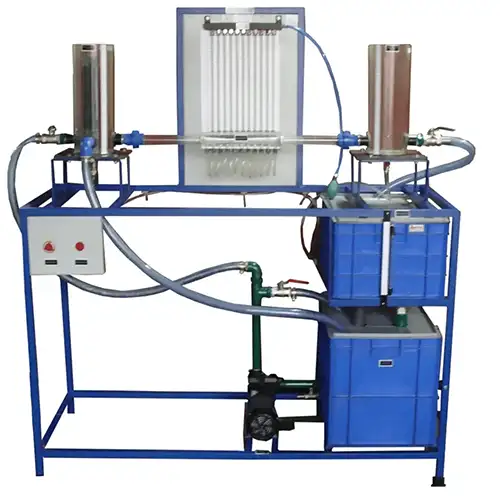
Description
An enhanced understanding of fluid mechanics principles is provided through advanced experimental setups by SV Technocrats India, Pune’s premier educational apparatus manufacturer. Designed for engineering laboratories and technical institutes nationwide, the Bernoulli’s Theorem Demonstration Apparatus is engineered to enable precise experimental verification of fluid dynamics.
Core Assumptions
In theoretical and experimental analyses, fluid behavior is governed by specific foundational parameters:
-
Incompressible Fluid: Constant fluid density ($\rho$) is maintained throughout the flow path.
-
Non-Viscous Fluid: Internal friction among fluid layers is assumed to be zero.
-
Steady Flow: Flow properties at any specific spatial coordinate are kept invariant over time.
-
Streamline Path: Energy equations are applied exclusively along a unified streamline.
Practical & Industrial Applications
The fundamental principles of Bernoulli’s theorem are applied across various engineering systems:
-
Venturi Effect: Fluid flow rates are measured in Venturi meters by monitoring pressure drops across constricted pipe sections.
-
Aerodynamics: Lift force on aerofoils is generated through controlled pressure variations.
-
Flow Measurement: Velocity measurements are accurately determined using orifice plates and Pitot tubes.
-
Hydraulic Engineering: Hydraulic structures like spillways and weirs are optimized using total head calculations.
Experimental Procedure
-
System Setup: A horizontal conduit with variable cross-sections is installed, and pressure taps are connected to piezometer tubes.
-
Flow Regulation: Steady flow conditions are established using an integrated pump, and discharge rate is measured.
-
Data Collection: Static pressure heads and flow velocities are recorded across varying cross-sectional areas.
-
Verification: Total energy heads are calculated and compared against theoretical expectations.
To ensure operational safety, all fluid connections must be secured against leakage, electrical pumps properly grounded, and pressure boundaries strictly maintained within designated limits by lab operators.
The Bernoulli’s theorem apparatus was invented and pioneered through the combined work of two major historical figures:
-
Daniel Bernoulli (The Theorist): A Swiss mathematician and physicist who formulated the theoretical principle itself. He established that an increase in fluid speed occurs simultaneously with a decrease in pressure, publishing his findings in his 1738 treatise Hydrodynamica.
-
Giovanni Battista Venturi (The Hardware Innovator): An Italian physicist who designed the first physical apparatus—the Venturi tube—in 1797 to practically test and demonstrate Bernoulli’s theorem. His constricted tube setup with vertical glass piezometer tubes is the direct forefather of the apparatus used in engineering labs today.