
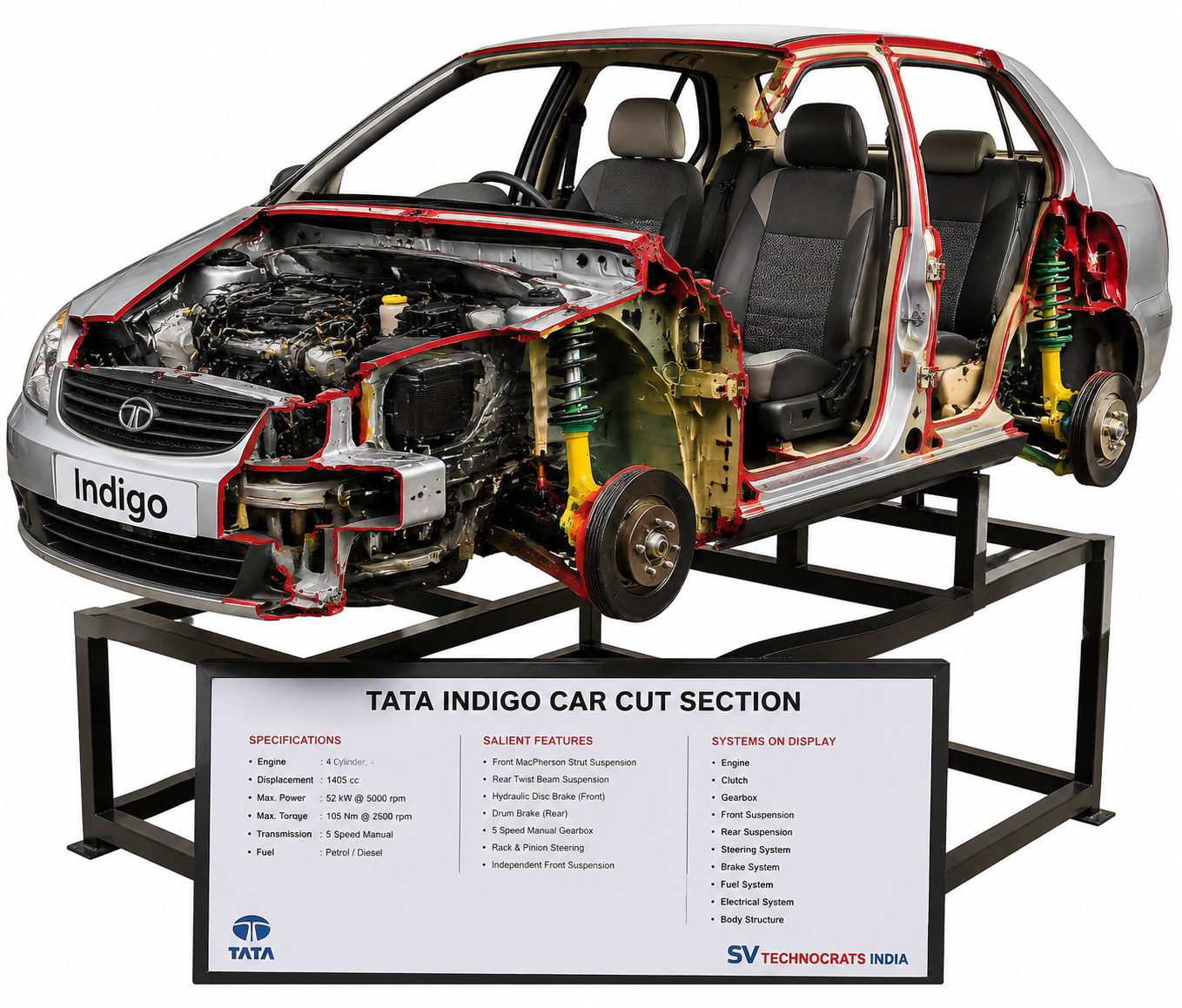
Description
Car Cut Section Manufacturer & Supplier in Pune
SV Technocrats India, Pune is a leading manufacturer and supplier of Car Cut Section Models designed for engineering colleges, polytechnic institutes, ITIs, vocational training centres, automobile workshops, and skill development laboratories. Our car cut section models provide a realistic and detailed view of the internal construction and working of an automobile. Students can easily identify major components and understand how different systems interact to ensure smooth vehicle operation.
The Car Cut Section Model transforms complex automotive concepts into practical learning experiences. Instead of relying only on textbooks, learners can observe real vehicle assemblies such as the engine, transmission, steering, suspension, braking system, electrical wiring, and body structure. This hands-on approach improves technical understanding, strengthens troubleshooting skills, and builds confidence in automotive maintenance and repair.
At SV Technocrats India, Pune, every cut section model is manufactured with precision using an actual vehicle. Our experts carefully cut and finish each section to expose important internal parts while preserving the structural integrity of the model. We paint exposed components with contrasting colours for easy identification and mount the vehicle securely on a heavy-duty steel frame for safe classroom demonstrations.
Key Features
- Manufactured from a real passenger car
- Clearly visible engine, gearbox, clutch, suspension, steering and brake systems
- Color-coded internal components for easy identification
- Mounted on a sturdy powder-coated steel frame
- Excellent visual aid for classroom and laboratory training
- Durable construction with low maintenance
- Suitable for demonstrations, practical sessions and technical workshops
- Custom cut sections available according to customer requirements
Educational Benefits
The Car Cut Section Model allows students to connect theoretical concepts with practical applications. They can inspect the arrangement of mechanical parts, understand power transmission, study suspension geometry, and observe the integration of electrical and mechanical systems. Trainers can explain vehicle construction more effectively, while students gain valuable exposure to real automotive engineering.
This model enhances classroom interaction, improves concept clarity, and supports competency-based technical education. It also helps learners prepare for industrial careers by providing practical knowledge of modern automobile systems.
Applications
Our Car Cut Section Models are widely used in:
- Engineering Colleges
- Polytechnic Institutes
- Industrial Training Institutes (ITI)
- Automotive Training Centres
- Skill Development Centres
- Vocational Training Institutes
- Automobile Workshops
- Research and Development Laboratories
Why Choose SV Technocrats India, Pune?
SV Technocrats India, Pune has earned a strong reputation for manufacturing high-quality laboratory equipment and automotive training models. We combine engineering expertise with advanced manufacturing techniques to deliver durable, accurate, and industry-oriented educational equipment. Our team focuses on quality, innovation, timely delivery, and customer satisfaction, making us a trusted partner for educational institutions across India.